
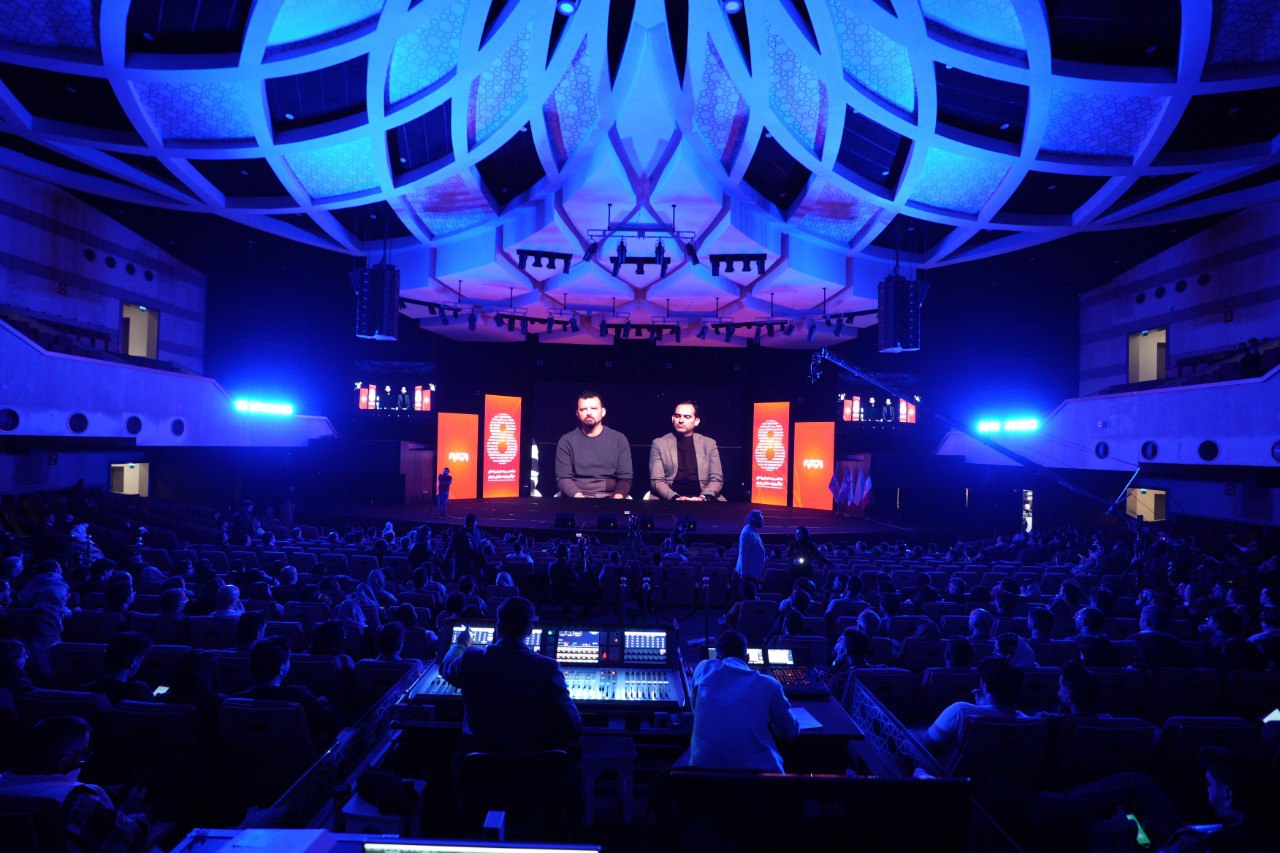
Yalda Summit: The Gateway to Iran’s Startup Ecosystem
On the longest night of the year—the ancient Persian winter solstice known as “Yalda”—families gather to ward off the darkness. But on January 10, 2026, inside the brutalist concrete spike of the Milad Tower, a different kind of gathering will take place.
Three thousand two hundred engineers, founders, and capital allocators will converge for the 9th Yalda Summit. They are not there to celebrate tradition. They are there to engineer survival.
To the untrained eye, this is a tech conference. To the global market analyst, this is Mission Control for one of the most resilient, hermetically sealed innovation ecosystems on Earth.
The Architect of “The Longest Night”
The Yalda Summit is the brainchild of the Shanbe Group and its founder, Akbar Hashemi. In a chaotic market, Hashemi functions less like a conference organizer and more like a Chief Systems Engineer.
In 2016, when the first Summit launched at the National Library, it was a support group for 500 frightened founders. They signed a literal “Covenant”—a pledge to stay and build despite the economic gravity crushing them. Nine years later, Hashemi has transformed that emotional pledge into a sophisticated industrial engine.
“The actions we take today will echo in the future,” represents the Shanbe doctrine. Under Hashemi’s direction, the Summit has evolved from a meetup into a National API—the single interface where government policy, industrial capital (CVCs), and agile startups plug into each other to prevent system failure.
The 2026 Telemetry: Artificial Intelligence as “Infrastructure”
If previous years were about e-commerce and fintech, the 9th Edition has shifted the trajectory entirely. The theme is Artificial Intelligence, but not in the way Silicon Valley discusses it.
in Silicon Valley, AI is about optimization. In Tehran, AI is about sovereignty.
The Summit’s focus on AI as “Vital Infrastructure” reveals the ecosystem’s strategy: If you cannot import intelligence, you must refine it. The 9th Summit is showcasing AI not as a feature, but as the only way to maintain competitiveness in a resource-constrained economy. The exhibition floor at Milad Tower—hosting hundreds of startups—is expected to demonstrate how Iranian code is solving Iranian problems: from logistics optimization in a sanctions-hit supply chain to fintech solutions running on local intranets.
The “Investment Café”: High-Friction Deal Making
For the global observer, the signal-to-noise ratio is highest in the “Cafe Sarmaye” (Investment Café).
This is the engine room. It is where the romanticism of startups dies, and the mechanics of capital begin. In 2019, this section hosted 150 negotiations in a single day. In 2026, it serves a critical function: bridging the gap between Iran’s traditional industrial giants (Steel, Petrochemicals, Mining) and the digital elite.
This is the Shanbe Group’s masterstroke: forcing the “Old Money” of Iran’s industrial sector to inject liquidity into the “New Money” of the digital sector via Corporate Venture Capital (CVC). It is a forced evolution that few other emerging markets have managed to execute so aggressively.
The Robotics Frontier
In a surprising tactical expansion, the 2026 Summit has opened a dedicated flight path for Robotics. This is not a toy fair. For a country needing to automate its industrial base, robotics is the hardware handshake to the AI software. The Summit provides the only stage where a robotic arm prototype can be seen by a Venture Capitalist and a Factory Owner simultaneously.
The Research Frontier: Computational Governance
For global research labs, the Summit offers a glimpse into how isolated nations deploy Artificial Intelligence.
The discourse has moved beyond simple chatbots. The 9th Edition focuses on the transition from linguistic mental models to Large Language Models (LLMs) designed for Governance and Economics. In a resource-constrained environment, AI is being positioned as a tool for computational modeling—solving complex national issues in healthcare and economics through data rather than bureaucracy.
The “Curse of Valuation”
The Summit does not shy away from the friction. A central theme of the “Hard Truth” sessions is the “Curse of Valuation.”
Startups in the ecosystem often trap themselves with unrealistic valuations, creating psychological anchors that make deal-making impossible with large holdings. The Summit acts as a correction mechanism, forcing founders to face the reality of the market: High paper valuations are useless without the liquidity that only the industrial giants can provide.
The Verdict
The Yalda Summit is a lens into a unique economic experiment. It is where Fakher Holding looks for code to move cargo, where Mobarakeh Steel looks for algorithms to melt iron, and where Akbar Hashemi’s Shanbe Group orchestrates the collision.
For the global observer, the lesson is clear: When a market is closed off, it does not stop growing. It grows inward, becoming denser, harder, and more integrated. The Yalda Summit is the annual measure of that density.
On January 10, the Milad Tower will not just host a conference. It will demonstrate a paradox: That the most restricted markets often produce the most unbreakable founders. The Yalda Summit is no longer just a celebration of the longest nigh by founderst; it is the design lab for the coming sunrise.







Post Comment